
A Concept Render Critique Scorecard That Controls for Polish Bias
A concept render can make an unresolved form feel settled. Use a design critique scorecard to separate what the image shows, what it suggests, and what still needs verification before handoff.
Record visible observations before judging the finish. Smooth reflections, controlled lighting, realistic materials, and a confident camera angle are presentation variables. They can influence preference without proving dimensions, mechanisms, ergonomics, material behavior, manufacturing feasibility, safety, compliance, market acceptance, or physical performance.
The Design Critique Scorecard
Use one row for each criterion. Write a short observation, identify the interpretation it supports, then route the unresolved question to the next appropriate review.
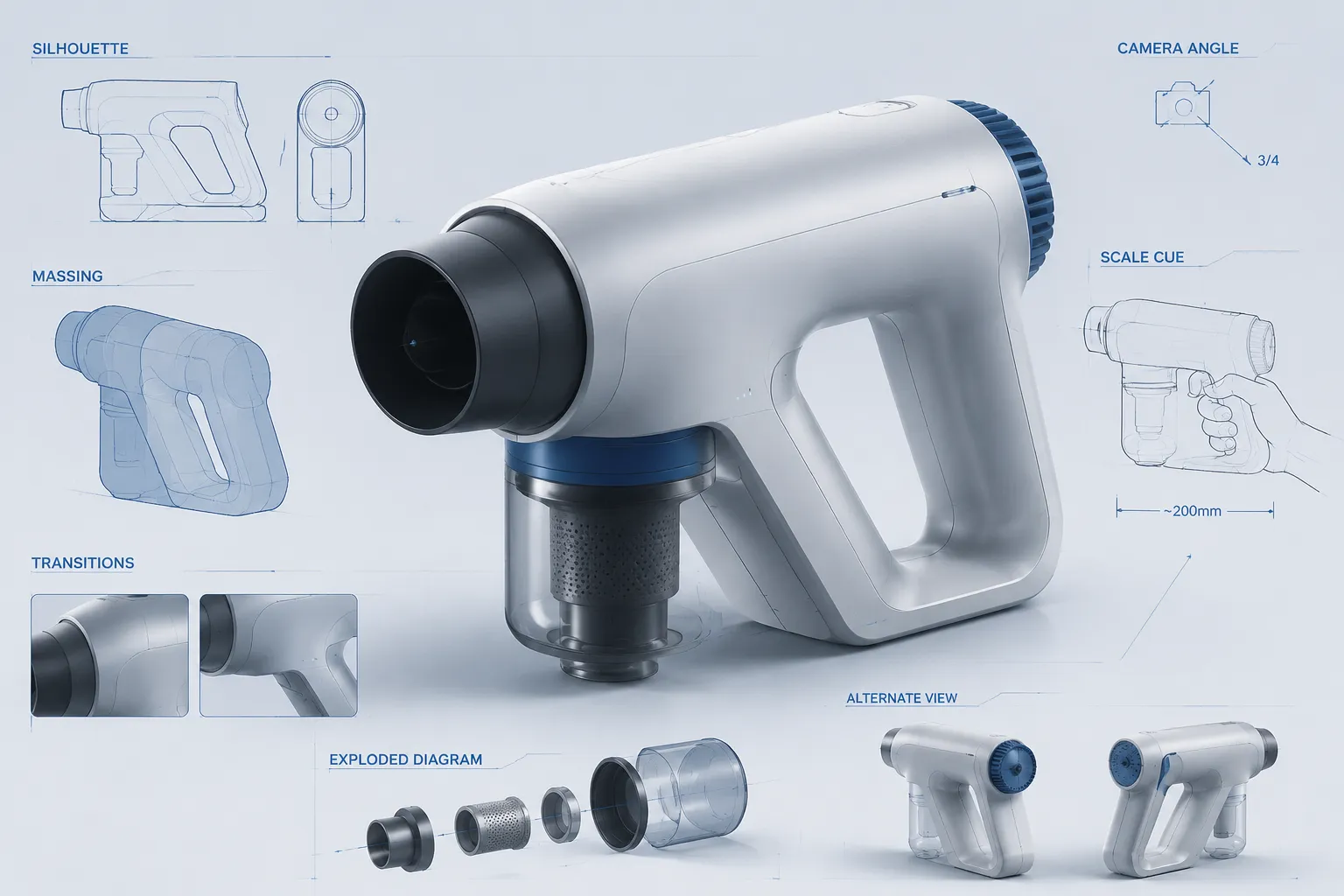
| Criterion | Record What Is Visible | Ask What It Suggests | Route What Remains Unresolved |
|---|---|---|---|
| Silhouette | Outer profile, openings, protrusions, and negative spaces | Does the product direction remain legible at a glance? | Compare sketches, orthographic views, or CAD |
| Massing | Relative size and visual weight of primary volumes | Does the object read as compact, heavy, light, tall, broad, or unstable? | Verify proportions and volume relationships |
| Proportion | Relationships between major parts and repeated features | Does the composition support the intended product character? | Check measured references, dimensions, or layout studies |
| Edge breaks | Sharp, softened, rolled, or visually absent corners | Where does the form change direction, and how clearly is that change communicated? | Confirm geometry and surface continuity |
| Transitions | Changes between shells, panels, controls, handles, or functional zones | Does the object read as one coherent form or several joined parts? | Inspect sections, assembly logic, or CAD |
| Scale cues | Hands, furniture, tools, known objects, or stated dimensions | Can the viewer estimate the object’s size without guessing? | Confirm scale with measured references |
| Finish and roughness | Gloss, matte response, translucency, texture, brushing, or reflection | Does the finish clarify form or pull attention away from it? | Review material intent, samples, and relevant physical conditions |
| Viewing angle | Camera height, distance, crop, lens impression, and visible surfaces | Does the selected view reveal the form fairly? | Compare additional views under consistent conditions |
| Use context | Placement, grip, posture, environment, and surrounding objects | What encounter or interaction does the image appear to communicate? | Review interaction, ergonomics, and real use conditions |
| Render polish | Lighting, reflections, shadows, background, retouching, and detail density | Is visual confidence coming from the form or from presentation treatment? | Compare a neutral clay, line, or shaded study |
| Handoff status | Labels, annotations, version information, and concept status | Can another reviewer distinguish intent from established information? | Attach assumptions and open questions to the next review |
This scorecard is editorial and diagnostic. It is not a validated measurement system. A low score does not mean the concept is poor, and a high score does not establish that the product can be made or used as shown.
Record Observation, Interpretation, and Verification
Keep each entry in three parts:
- Observation: What can a reviewer point to in the image?
- Interpretation: What does that visible feature appear to communicate?
- Verification: What must be checked elsewhere before the interpretation becomes a design decision?
For example:
- Observation: The main housing has a broad shoulder that narrows sharply toward the base.
- Interpretation: The render communicates a top-heavy, technical massing direction.
- Verification: Compare the transition in a side view and confirm whether the narrowing belongs to the intended geometry.
This structure keeps a reaction such as “the product feels premium” from standing alone. The reviewer must identify the visible cause and state which part of the reading remains inferential.
Start With Silhouette and Massing
Silhouette is a useful first check because it survives many presentation changes. Reduce the render to a flat outline or inspect it at a small size. Record the dominant profile, the widest section, and any distinctive cutouts or appendages.
A clear silhouette can communicate category, posture, and visual hierarchy. It does not settle the internal arrangement. The outer form only establishes what the image makes easy to recognize.
For massing, identify the primary body, secondary volumes, supports, and lighter details. Ask whether contrast, shadow, size, or placement gives one component more visual weight than intended. When the rear, underside, or side volume affects the decision, compare another view and record the viewing condition.
Check Proportion and Transitions
Trace relationships instead of relying on broad adjectives. Compare body width with height, control size with surrounding surface area, handle length with the housing, opening size with wall thickness, and support spacing with the apparent visual center of mass.
The render may communicate a deliberate proportion system, but it cannot establish exact dimensions without measured references. Note whether the judgment comes from a visible relationship, a known reference, or an assumption.
Edge breaks show where a surface changes direction. Look for highlight movement, shadow boundaries, line treatment, and changes in roughness. A bright reflection can hide a transition, while a dark seam may read as a gap, groove, shadow, or material change.
Transitions deserve their own record when they communicate assembly, material separation, or a functional zone. The render introduces that reading, but it may not reveal how the parts relate physically. Compare a close detail with the full view: the detail exposes the break, while the full view shows whether it supports the overall hierarchy.
Use Finish, Camera, and Context as Variables
Finish cues affect how viewers read curvature and material separation. Gloss can reveal broad reflections; matte surfaces can reduce highlight information; texture can add structure; dark surfaces can conceal edges; bright surfaces can exaggerate them.
Ask whether the reflection clarifies the form, whether roughness distinguishes adjacent parts, and whether the background creates a false edge. A render can show intended appearance. It does not establish how a physical material will behave under different lighting, wear, handling, or manufacturing variation.
The camera is part of the argument. A low view can increase apparent height, a close crop can enlarge the object, and a three-quarter view can reveal some surfaces while hiding alignment problems. Record camera height, approximate distance, direction, crop, visible surfaces, and scale cue before comparing directions.
Use the same camera position, crop, lighting logic, background treatment, detail level, and scale cue when alternatives must be compared. When those conditions differ, record the difference. It may explain the preference.
Context can clarify placement and intended encounter, but it also introduces assumptions. Check whether nearby objects provide a reliable scale reference, whether the posture implies interaction, and whether the environment hides the rear, underside, or support condition.
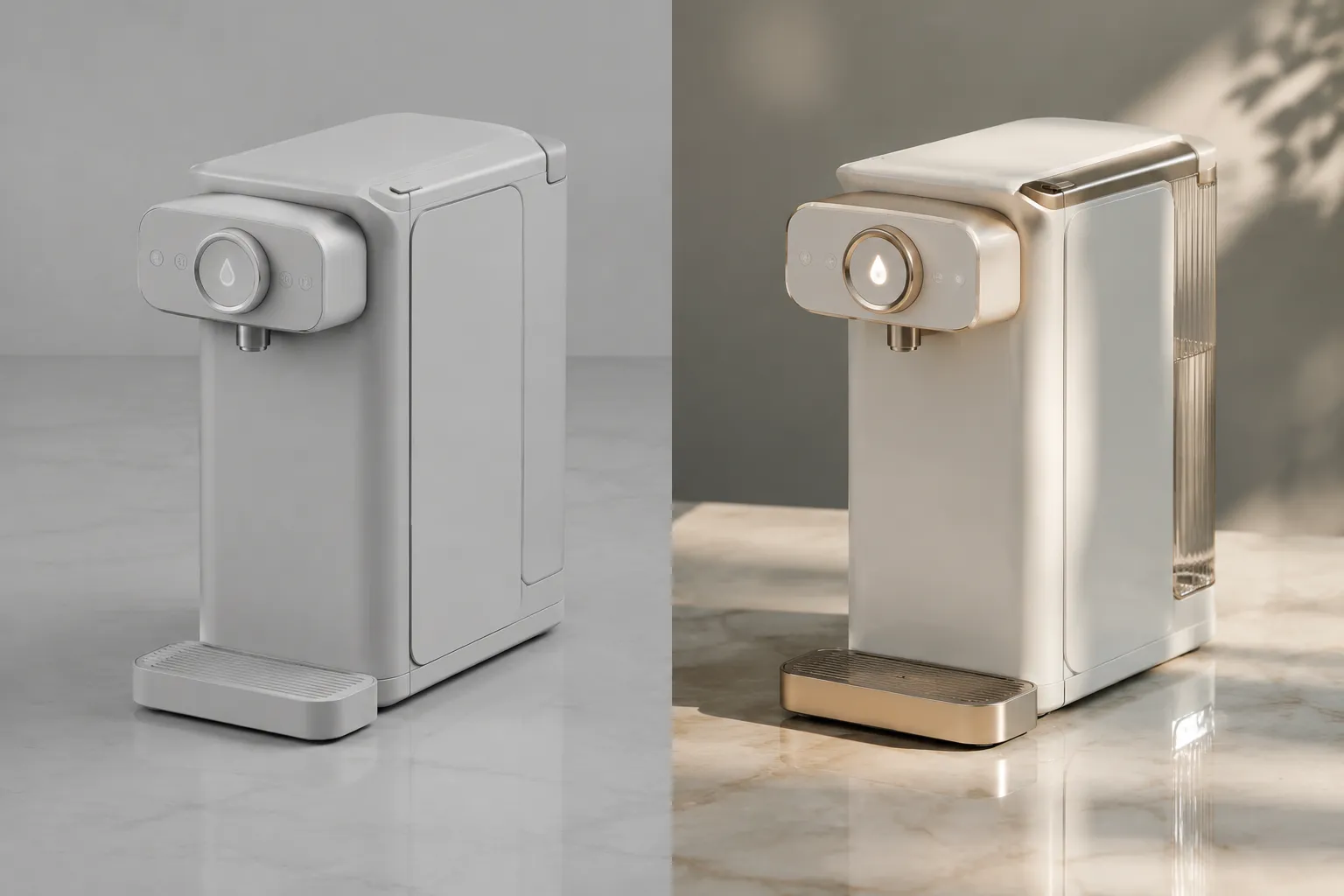
Run Two Passes to Control Polish Bias
Pass One: Neutral Read
Inspect the sketch, clay render, shaded study, or low-detail preview before the finished image. Record silhouette, massing, main proportions, major transitions, visible openings, controls, scale cues, and unresolved areas. Leave material appeal and lighting quality out of this pass.
Pass Two: Presentation Read
Inspect what the polished render adds: finish hierarchy, reflections, shadow depth, context, camera emphasis, color separation, and detail density. Compare the two records and ask which judgments remain stable.
A stable judgment may concern the outer silhouette or broad massing. A presentation-dependent judgment may concern perceived quality, material confidence, or apparent precision. Use more cautious wording for the second category and identify the presentation condition that shaped the reaction.
Polish is not a defect. It becomes misleading when it receives credit for information the image does not contain.
Worked Illustrative Entry
The following example is hypothetical. It illustrates the recording method rather than reporting a product test.
- Concept direction: A compact countertop device with a rounded upper housing and a dark lower base.
- Observation: A continuous highlight crosses the front curve, while the darker base visually recedes.
- Interpretation: The render communicates a lighter upper body resting on a visually stable base. The highlight makes the upper transition appear smooth.
- Comparison: In a neutral shaded view, the front curve remains legible, but the base-to-housing relationship is less distinct.
- Unresolved assumption: The image does not establish whether the dark base is a separate component, a recess, or a finish change.
- Handoff action: Confirm the transition in a sectioned CAD view and record the intended part or material boundary.
The entry gives the next reviewer a specific question. It does not turn a visual effect into a physical fact.

What the Render Can and Cannot Settle
A concept render can support discussion when the outer silhouette, primary volumes, broad proportions, edge breaks, transitions, scale cues, camera position, and image status are clear. These are communication checks. They describe the usefulness of the image for review, not the readiness of the product behind it.
Route missing evidence according to the question:
- Dimensions and geometry: measured references, CAD, sections, or controlled views.
- Mechanisms and interfaces: mechanism studies, exploded views, or engineering review.
- Ergonomics and control reach: interaction studies, physical mockups, or appropriate ergonomic review.
- Material behavior: specifications, samples, and physical observation under relevant conditions.
- Manufacturing and assembly: engineering and manufacturing review.
- Safety and compliance: the applicable documented review process.
- Source ownership and reuse permission: source confirmation and rights review.
- Physical performance: a defined test or prototype evaluation.
The image can identify a question. It cannot answer every question created by the product.
Prepare the Handoff Record
Attach five fields before the image moves forward:
- Visible observations
- Interpretations based on those observations
- Comparison views or references used
- Unresolved assumptions
- Next owner or review route
Keep observations and interpretations on separate lines. A later reviewer may accept the observation while challenging the interpretation, or accept the interpretation while requesting stronger evidence.
The concept render establishes the intended front silhouette, broad massing, and contrast between the upper housing and lower base. The camera hides the rear transition and underside. Material behavior, control reach, internal mechanism, and assembly logic remain untested. Review the rear view, section detail, and interaction study before selecting this direction.
Final Review Check
Ask whether the same design judgment survives a less polished view, a second angle, and a recorded scale cue. If it does, the judgment is more closely tied to visible form evidence. If it does not, record the presentation condition that shaped the reaction.
Decide now what the render communicates: silhouette, massing, proportion, transitions, finish cues, viewing angle, and use context. Keep unresolved behavior and performance questions open, then route each one to the CAD, engineering, rights, material, interaction, or physical-testing review that can address it.
Sources
- What you see is not always what you get: A qualitative, comparative analysis of ex ante visualizations with ex post photography of landscape and architectural projects
- Design Drawing Parameters and its Impact on the Evaluation of Design Proposals
- Evaluation of virtual prototypes: literature and empirical findings
- Visual Quality and Response Assessment: An Experimental Technique
- Reading landscape design representations as an interplay of validity, readability and interactivity: a framework for visual content analysis
- Evaluating Architectural Design Review
- All Buildings Great and Small: Design Review From High Rise to Houses